Meta Business Agent: Should Your UK Business Let AI Answer Its DMs?
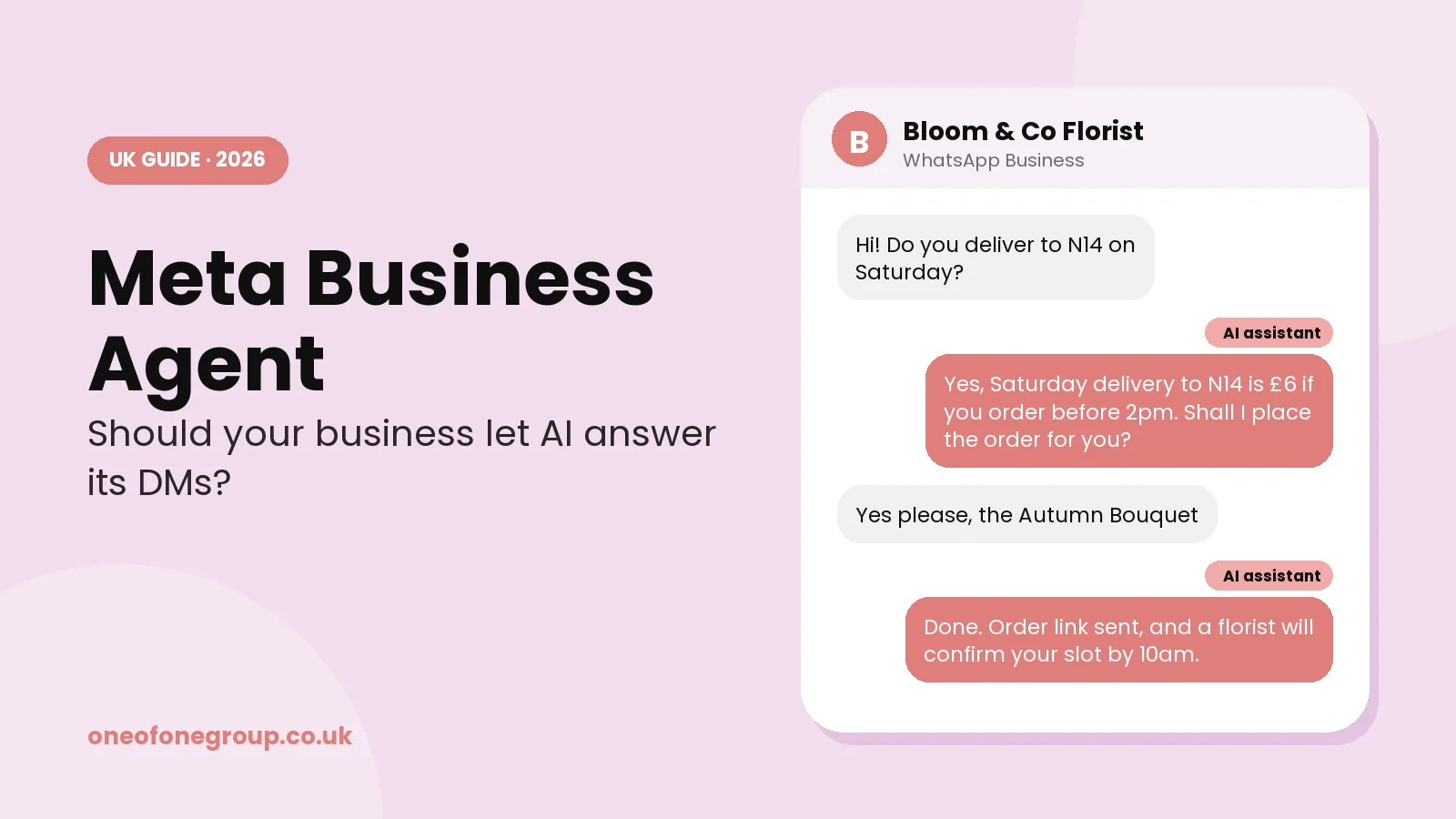
Meta Business Agent is the AI assistant that now replies to customers inside WhatsApp, Messenger and Instagram DMs on a business's behalf. It answers questions, recommends products from your catalogue, books appointments and passes the conversation to a person when it gets stuck. Meta opened it to businesses of every size on 3 June 2026 at its Conversations event in London, after close to two years of testing in India and Mexico.
More than a million businesses were already using it on WhatsApp and Messenger before that launch. Getting started is free for now, and Meta has said paid subscription tiers will follow. For a UK salon, clinic, restaurant or shop, the practical question is whether to switch it on, and how to do that without the agent saying something you would never say to a customer.
This guide covers what the agent actually does, what it is likely to cost, where it goes wrong and how to set it up properly.
What is Meta Business Agent?
Meta Business Agent is a chatbot built on your own business information rather than a generic one. According to Meta's launch announcement, it can:
- Answer questions about your business, such as opening hours, prices, parking and policies
- Recommend products or services from a connected catalogue
- Book appointments and qualify sales leads
- Hand the conversation to a team member at the point you choose
- Reply in the customer's language, in your tone of voice
It lives inside the messaging apps your customers already use. There is no widget to add to your website and nothing for the customer to install. When someone messages your WhatsApp Business number, your Facebook Page or, as the rollout reaches it, your Instagram account, the agent replies in the same thread.
Meta also sells a separate Business Agent Platform for larger companies that want to connect the agent to systems such as Shopify and Zendesk. Most businesses this guide is written for will use the built-in version.
Why this matters more in the UK than almost anywhere
Ofcom's Online Nation 2025 report found that 90% of UK online adults used WhatsApp in May 2025, and 74% opened it every single day. TikTok, by comparison, reached 56%. Instagram's UK advertising audience stood at 35.5 million in late 2025 and Messenger's at 25.7 million, according to Digital 2026: The United Kingdom.
Those are the inboxes where your customers already are. Meta says businesses now handle more than a billion active message threads a day across WhatsApp, Messenger and Instagram.
Expectations have moved as well. The Sprout Social Index has found for several years running that nearly three-quarters of consumers expect a brand to reply on social within 24 hours. For a two-chair salon or a family-run restaurant, that means answering messages at 10pm on a Saturday or losing the booking to whoever does.
That gap between what customers expect and what a small team can deliver is the problem the Business Agent exists to solve.
What Meta Business Agent costs
Meta's own line is that getting started is free, with paid subscription options for businesses of every size arriving in the coming months. TechCrunch reported that Meta plans to fold the agent into WhatsApp Business Premium tiers for smaller businesses and to charge larger businesses by usage.
For businesses on the developer platform, the version used by WhatsApp API partners, usage billing has already begun. 360dialog, a WhatsApp partner, reports a rate of $2 per million tokens from 1 August 2026, with a typical conversation using 20,000 to 25,000 tokens. That works out at around 3p to 4p per conversation at current exchange rates. Meta had not published pricing for the small-business app version at the time of writing, so plan on the assumption that the free period will end.
The bigger cost is not the fee. It is the time needed to give the agent accurate information and to check what it says. Skip that and the savings disappear into refunds and apologies.
Where it helps, business by business
| Business | Jobs the agent can take | Keep a person on |
|---|---|---|
| Hair salons and barbers | Opening hours, price list, which stylist does what, availability, deposit and cancellation policy, basic aftercare | Colour corrections, consultations, complaints about a result |
| Dentists and clinics | Treatment menu, finance options in general terms, location and parking, booking a consultation, new-patient forms | Anything clinical, pain, emergencies, advice on a specific case |
| Restaurants, cafés and bars | Table availability, menus, allergens already listed on the menu, private hire first contact, bank holiday hours | Large events, complaints, dietary questions the menu does not cover |
| Florists and gift retailers | Delivery areas and cut-off times, what is in a bouquet, prices, order status where connected, wedding enquiry first contact | Bespoke wedding and event work, sympathy orders, substitutions |
| Online shops | Sizing, stock, delivery times, returns policy, product recommendations from the catalogue | Refund disputes, damaged orders, anything needing a judgement call |
| B2B and professional services | Explaining services, qualifying a lead with a few questions, booking a discovery call, sending a brochure | Pricing, scope, anything with legal or financial weight |
Two patterns run through that table. The agent is strong on repetitive, factual questions where the answer sits in your catalogue or your notes. It is weak wherever the right answer depends on judgement, regulation or an upset customer.
Where it goes wrong
It only knows what you tell it
The agent answers from your profile, your catalogue, documents you upload and, on the platform version, your website. If your price list is a photo in a pinned post from 2024, it will either guess or say it does not know. Guessing is worse. A confident wrong price, in writing, is a complaint waiting to happen.
It cannot read the room
A customer who has been let down wants a person, quickly. Meta says the agent hands over when it is unsure, when it detects a policy problem or when the customer asks for a human. Somebody has to be watching for those handovers, especially in the evening and at weekends, or the customer simply gets silence with extra steps.
Regulated advice
Dentists, aesthetic clinics and anyone selling financial or legal services should not let an AI give clinical or professional advice by DM. Set it to book a consultation and stop there.
Tone drift
Out of the box the agent sounds like every other chatbot. If your brand voice is dry, warm or a little cheeky, you need to tell it so in plain words, give it examples, and then read the transcripts to check it listened.
Telling customers it is AI
Meta's public material does not say whether customers see an AI label in the chat. Do not rely on it. Add a line to your first automated reply saying it is an AI assistant and how to reach a person. Customers forgive a bot for being a bot. They do not forgive being tricked.
How to set it up properly
- Pull your last 100 messages. Group them by question. In most small businesses, 15 to 20 questions cover the bulk of the inbox: hours, prices, availability, parking, deposits, cancellations, allergens, delivery.
- Write the answers down once, properly. One document, plain English, current prices, exact policies. This is the agent's brain. Update it every time something changes.
- Connect your catalogue and bookings. Products and services in Meta's catalogue can be recommended directly. If bookings live in a separate system, decide whether the agent collects the details for you or sends a booking link.
- Set the tone and the no-go list. Give it two or three example replies in your voice. Then list what it must never do: no medical advice, no discounts, no promises about delivery dates.
- Decide the handover rules. Complaints, refunds, anything about a specific order or patient, anything it is unsure about. Name who picks these up and how quickly.
- Turn it on. In the WhatsApp Business app, open the Tools tab and choose Your Business AI, then follow the guided setup. Meta links setup for Messenger and Instagram from its Business AI hub at facebook.com/business/ai. Instagram is rolling out in stages, so it may not appear for every account yet.
- Test it as a customer. Ask three people who do not work for you to message the account with awkward questions. Fix what breaks before real customers find it.
- Read the transcripts weekly. Every wrong answer is a missing line in your document. After a month you will have a far better FAQ than you started with, and a list of questions your website should be answering too.
Where it fits with the rest of your social media
An agent in your inbox does nothing if nobody messages you. The content still has to earn the conversation: Reels that show the work, posts that answer the questions people search for, ads with a reason to get in touch. Meta is currently testing a Reply to Keywords option for Instagram ads that sends a private message when someone comments with a chosen word. That is the front end of exactly this pipeline: comment, DM, agent, booking.
So treat the agent as one part of a social media operation rather than a bolt-on. The businesses that get value from it are the ones whose content, offers and inbox all say the same thing. Our guides to social media marketing for small businesses and what social media management costs in the UK cover the rest of that system, and our content creation team produces the posts and Reels that start the conversations in the first place.
Should you switch it on?
Yes, if you already receive more messages than you can answer within an hour, most of them ask the same things, and your prices and policies are written down somewhere current.
Not yet, if your inbox is mostly complaints and one-off requests, if you sell anything regulated and have not written the no-go list, or if nobody in the business will read the transcripts. A bad automated reply is public in a way a slow human one is not.
One of One Group manages social media for hair salons, dentists, restaurants, florists and growing brands across London and the UK, covering the content, the community management and the inbox. If you want the agent set up around a proper content plan, with a person still behind it, that is part of our social media management service. See our clients for the kind of businesses we work with.
Book a free social media consultation and we will look at your inbox, your content and where an AI agent would genuinely help.
Frequently asked questions
Is Meta Business Agent free?
Getting started is free at the moment. Meta has said paid subscription tiers for businesses of every size will follow, and WhatsApp API partners report usage-based billing on the developer platform since August 2026. Expect to pay something for it within the year.
Does Meta Business Agent work on Instagram?
Meta announced the Instagram expansion at the June 2026 launch and it is rolling out in stages. If it is not showing for your account yet, WhatsApp Business and Messenger are available now and Instagram should follow.
Can it book appointments?
Yes. Appointment booking and lead qualification are two of the headline features. How well it works depends on whether your availability lives somewhere the agent can read, or whether it needs to collect details for you to confirm by hand.
Will customers know they are talking to AI?
Meta's launch material does not confirm an on-screen label, so build the disclosure into your own first reply. Tell people it is an AI assistant and how to reach a member of the team.
Do I still need a social media manager?
The agent handles replies. It does not plan content, film Reels, run ads, spot a complaint turning into a reputation problem or notice that the same question keeps coming up because your website is unclear. Those jobs are still human, and they are the ones that decide whether anybody messages you at all.